Friday, October 23, 2009

Western Cape Primary Science Program


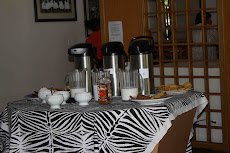
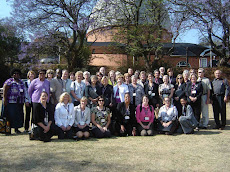
Delegates had an opportunity to visit the Western Cape primary Science Program to learn more about teacher professional development support. This program trains primary teachers in the methods and content of teaching science, with an emphasis on environmental science. Beginning with a visit led by Sven to their wetland education area and bird blind (which they call a bird hide)we walked through a small wetland preserve that has been in existence for over 50 years. We went into a bird blind to watch some of the 50 species of birds that call the wetland home. There were calla lilies throughout the grassy areas. A species of frog lives inside the calla lily flower but we didn't get to go peeking through the lilies to find one. We returned to the center to be greeted with tea, milk tart, and other assorted tea cakes- a tradition we are met with frequently here in South Africa that we find quite nice and so civilized! After a presentation on the work of the center, the teachers broke into small groups with staff to discuss special topics such as instructional materials, support for content learning, etc. hey have a nice web site at http://www.psp.org.za/ . The delegation presented several nice gifts for the Center to Director Leslie Liddle and staff and a certificate of appreciation.

Morning at the Aquila Reserve


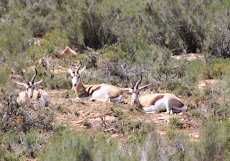
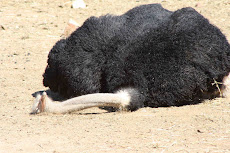
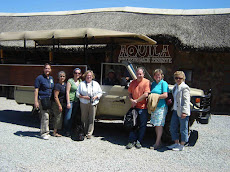
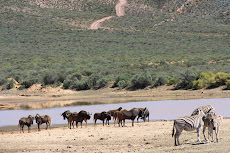
Page, Charlotte, Cliff, Debra, Andi, Carol, and Jan departed for a 2 hour early morning ride up to Aquila, a private game reserve, to go on a mini-safari. We were greeted at the lodge with champagne and treated to a delicious breakfast in the main lodge. It was a beautiful building with a thatched roof. The breakfast was an extensive buffet of eggs, meats, fresh veggies, beans, and fruits (love the passion fruit!), cheeses, cereals, fresh breads and pastries. The hot dishes were cooked in cast iron pots on individual cast iron stoves. After breakfast we departed in our open vehicle for a 3 hour safari ride throughout the extensive reserve. We saw all of the big 5 plus ostriches, water fowl, several types of antelope, zebra, giraffe, and more. Scroll down further and you will see the photos of the fauna.

The photos taken on safari are available for downloading at: http://picasaweb.google.com/pagekeeley/AquilaSafariPhotos#

Cape Floral Kingdom


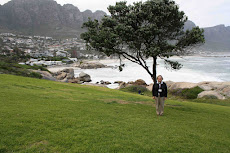
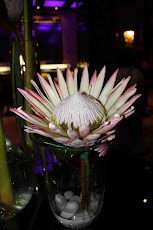
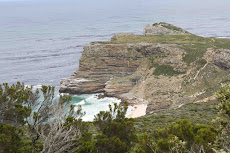
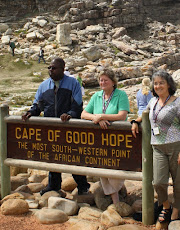
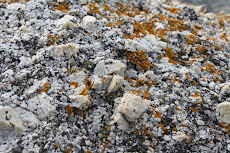
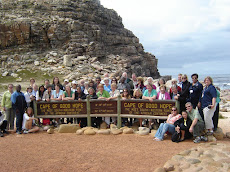
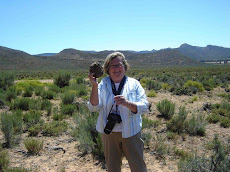
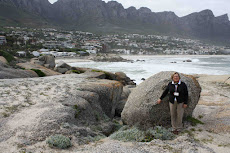
The Cape of Good Hope is part of the Cape Floral Kingdom, the smallest but richest of the world's six floral kingdoms. This comprises a treasure trove of 1100 species of indigenous plants, of which a number occur naturally nowhere else on earth! The park abounds in these beautiful protea. African daisies grew everywhere but somehow I didn't get a photo of them! Noticethe red color of the rock lichens seen throughout the park.

We Are Who We Are Because of Who We Were- The Origins Museum


We visited the Origins Center at Wits University - a world class museum with artifact and multimedia exhibits that showcase Africa's rich and mysterious past- the cradle of human civilization. The above title is the motto of the museum. Between 150,000 and 200,000 years ago modern Homo sapiens evolved in Africa. They then left the continent and settled throughout the entire world. With head sets we started our journey with the origins of humankind in Africa and then moved through the development of art, symbolism, and ancient tools. The journey then continues through an amazing exhibit of the diverse African rock art and the stories told on these ancient rocks. Many of the rocks showed the hunting of the eland, an African large antelope that is still revered today. We also had an opportunity to see the art and experience through video the oldest known ritual that is still practiced today – the San/Bushman trance dance.

Gold Mining in South Africa


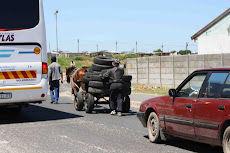
Driving along in Johannesburg one will see these huge flat mountain-like features. This picture was taken from the bus as we drove to Soweto. What appears to be a mountain is actually the tailings dug up from years of gold mining, a major industry in S. Africa that utilized cheap labor in the mines during the apartheid era. Environmentally they pose a problem because of cyanide leaching.

Hector Pieterson


After our tour of Soweto, we traveled to the Hector Pieterson Museum. Hector Pieterson, age 13, was the first student to be killed during the 1976 Student Uprising in Soweto. He has since become a symbol of the youth resistance to apartheid. The famous Soweto uprising started as a peaceful protest march organized by school students in Soweto against the Bantu education system. Imagine- school students protesting against the inequity of their education- that is how important education is to Africans! One of the main grievances was that Afrikaans, regarded as the language of the oppressor, had to be taught in 50% of the classes and the other 50% had to be taught in English.


Hundreds of students joined the protest march planned by the South African Student Movement (SASM), to the Orlando Stadium East where they intended to meet with the authorities to voice their grievances. They carried placards with slogans – ‘Away with Afrikaans’, ‘Amandla Awehtu’ (Power to the People), ‘Free Azania’ (Free South Africa) and sang ‘Nkosi Sikelel’ iAfrika’ (God bless Africa), now the national anthem of South Africa.

Refilwe, our guide, is explaining the famous photograph of Hector Pieterson being carried after he was shot when police confronted the marchers and ordered them to disperse. Despite the peaceful nature of the march, the confrontation turned violent and a number of students, including Hector Pieterson, were shot and killed. What was a student march, quickly erupted into an uprising, which spread to many other parts of the country. The photograph shows a young man, Mbuyiswa, carrying Hector Pieterson in his arms, and captured the attention of people throughout the world, highlighting the injustices of apartheid. The park also has a plaque honoring Mbuyiswa.

Although we didn't spend a lot of time at the museum since lunch ran so late, we had enough time to read much of the exhibits and learn so much that we did not know about the Soweto riots. For example, many of us knew it was a riot against Apartheid but we had no idea it started as an organized, peaceful march by school children!

Soweto- Mandela's House


Nelson Mandela's home where he lived before he was imprisoned is now a historic site. The fenced part is looking from the back corner of the road the house is on in the Orlano district of Soweto. Next to his home is a restaurant - I don't know if this was a family business or if it is merely named after him because it is next door. Mandela now has a home in the affluent section of Soweto.

Soweto- A Township of Many Contrasts


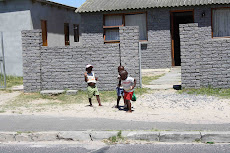
The bus tour through the township of Soweto was quite sobering. Housing ranged from the shack slums to the matchbook houses built by the government for the Soweto residents to the luxury homes of the rich and famous (where Nelson Mandela and Desmond Tutu live). The painted towers are left over cooling towers from a power plant that are now used for bungie jumping.

Dining in South Africa- Cape Town Fish Market


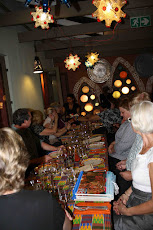
Dining in South Africa is certainly a culinary experience. The restaurants are fabulous and the variety of foods and cuisine, quite eclectic. For the foodies in the group, we enjoyed the variety of eating establishments chosen for us by the People to People program as well as ones we discovered on our own on our "meals on us" nights. Our first group lunch was at the Cape Town Fish Market in Johannesburg. Despite the fact that it took so long for our group of 40+ to be served a 3 course lunch, it was quite good. Notice the bar area that has a revolving sushi bar! Over 50 varieties of sushi slowly revolve around the bar and when you want one, you just take it off the "track" and the number on the plate records what you took. Most chose the fish which was excellent. Notice our Louisiana co-leader, Charlotte, and delegate, Rhonda, also from Louisiana found a taste of the Bayou Country right here in Johannesburg! For my entree, I had the African chicken curry served in the traditional iron curry pot. Yum!

Education in South Africa


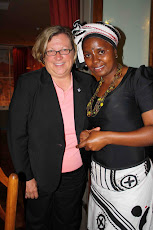
Both Dr. Marisa Rollnick and Dr. Linda Marais (that is Dr. Marais in the photo receiving a certificate of appreciation from our delegation and gifts for her program) gave us insights into teaching and learning in South Africa. Imagine trying to teach science with few materials, no water, and sometimes no electricity. On top of that, the teachers are often lacking credntials to teach science and professional development can't be offered during the school day which means it is only available on holidays and weekends, when teachers need to take care of family. Imagine trying to teach students who go home to a home where their parents may be missing for up to a month at a time while they seek work elsewhere and the children become the de facto parents; or even worse, children who live in families devastated by AIDS where they are left to raise their younger siblings. It is so sad, yet these children cherish their education and see it as something very important to their lives.

Imagine trying to teach in a country that has 11 official languages- Zulu (the most frequently spoken), English, Afrikaans, Ndebele, Xhosa, Sepedi, Sesotho, Setswana, SiSwati, Tshivenda, and Xitsonga as well as numerous European languages and other African languages such as Urdu. The primary language used for teaching in the schools is English even though it is not the mother tongue of many students. One of the delegates asked Linda Marais, Director of the TRAC program (see http://www.trac.sun.ac.za/ ) if instructional materials were translated into different languages, much the way they are in our country. The answer was an emphatic NO and the reason was surprising. While acknowledging the difficulties of learning science in a language that is not spoken at home, she also clearly stated the goals of teaching science: to prepare students for jobs, and to live and fully participate in a democratic society.Having students understand science in their native language isn’t the real goal, it’s opening students to opportunity.To do that, they have to know science in English. Particularly for jobs in science and engineering. Thus these subjects are taught only in English and surprisingly, the students we met where quite fluent in the language.

Different Views of Table Mountain and the "Table Cloth"


The view of Table Mountain (top photo) from our hotel was breathtaking! Table Mountain is an iconic part of the landscape in Cape Town. Whether we were coming in to Cape Town, at our hotel, down on the water front, etc. the many views of the mountain were awesome! Driving to and from the airport to Cape Town, we could always see the mountain zebras grazing on the bottom slope of Table Mountain. Table Mountain is famous for its "white table cloth" which descends on the mountain top in early evening, made up of thin, wispy clouds that appear to flow over the "table top" only to dissipate into the air part way down the slope. You could see the condensation being balanced by the evaporation- almost like an equilibrium situation. In the early evening the warm moist air rising from the south during the warm day condenses into a cloud layer as it reaches the cooler mountain top, spills over the mountain and dissipates when it reaches the warmer, lower altitude of the mountain. At least I think that is the explanation! The guest group went up the funicula to visit the top and several of our group hiked up the mountain on our day off.

Wednesday, October 21, 2009

A Shimmering Silver Tree!

This beautiful tree grows on the Cape Peninsula and can be found on the slopes of Table Mountain. It grows in the biome area called fynbos- characterized by the shrubby vegetation. It gets its name from the silvery sheen caused by many fine satiny hairs on its grey-green leaves. It feels soft and velvety and shimmers when the sun hits it. It is now a protected tree.

Nelson Mandela Bird of Paradise


The Bird of Paradise looks like an exotic bird peeking out of a broad leaf. Although many of us associate the orange vaiety with stem cuttings at the florist shop, tropical place like Hawaii, or California where it is the city flower of Los Angeles, it is actually native to South Africa. It grows wild in the Cape. This yellow sepaled variety is named after Nelson Mandela and is in the Kirstenbosch Botannical Gardens. At the Botanical Garden, the curator had access to 7 yellow Bird of Paradise plants and spent the next 20+ years hand-pollinating them with each other to increase the stock. Their first yellow bird of paradise introduced to the trade market (you can buy seeds in the U.S. from companies like Thompson and Morgan) was released under the name 'Kirstenbosch Gold'. In 1996, they were given permission to re-name it in honor of Nelson Mandela.


Flora in South Africa- The Cape Floral Kingdom


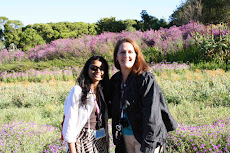
The flora are beautiful in South Africa. From lavender jacarunda trees in Johannesburg to the majestic proteas in Cape Town- as Vanessa would say- they are "drop dead gorgeous"! On Saturday we strolled through the Kirstenbosch Botannical Gardens. Walking among the Cycads felt like a scene out of Jurassic Park. The calla lilies bloom everywhere!

The plants we saw in the botannical garden and throughout our excursions on the Cape belong to the Cape Floral Kingdom - the smallest of the six Floral Kingdoms in the world, and is the only one contained in its entirety within a single country. The Cape Floral Kingdom is characterized by its high richness in plant species (8,700 species) and its high endemicity (68% of plant species are confined to the Cape Floral Kingdom). The Cape Floral Kingdom thus compares with some of the richest floras worldwide, surpassing many tropical forest regions in its floral diversity (read more on the Fynbos and Cape Floral Kingdom at: http://www.plantzafrica.com/vegetation/fynbos.htm )